This is probably how you hang your paintings:
The Wrong Way to Hang a Painting
Cat, Henriëtte Ronner-Knip, 1897

But this is how I hang mine:
Unfortunately, management has noticed that your painting hangs perfectly well from a single nail. Naturally, they’ve cut your nail budget in half.
You could accept this. Or you could find a way to hang the painting so that it stays up with both nails, but falls when either one is removed.
Can you make both nails indispensable?
Back to Basics
Let’s simplify it to just one nail. Suppose you have the cord wrapped clockwise around the nail.
The cord would fall if somehow your wrap was undone. So you can, in a way, wrap it again counterclockwise to undo what you did.
Let’s represent a clockwise wrap with A and a counterclockwise wrap with a.
Mathematicians may prefer A⁻¹. We've gone with a to satiate management's hatred for mathematicians.
We can now write what we just did as Aa. The A and a cancel each other, so the cord falls.
NEED MORE NAILS
If you wanted A and a to not immediately cancel each other, you’d have to separate them somehow.
You can do just this by introducing nail B.
So how would ABa behave? Notice that removing B leaves just Aa, which cancel each other. But removing nail A leaves B, which means it will still hang onto nail B.
If we wanted B to cancel out too, we'd just have to add its inverse (which is b). So it becomes ABab.
That is clockwise A, clockwise B, counterclockwise A, counterclockwise B.
Code it Up
Let's put the cancellation rule into code.
// assert!(are_inverses('A', 'a'));
// assert!(!are_inverses('A', 'A'));
fn are_inverses(a: char, b: char) -> bool {
    a != b && a.eq_ignore_ascii_case(&b)
}

fn reduce(word: &str) -> String {
    let mut stack = Vec::new();

    for letter in word.chars() {
        match stack.last() {
            Some(&last) if are_inverses(last, letter) => {
                stack.pop();
            }
            _ => stack.push(letter),
        }
    }

    stack.into_iter().collect()
}
The original code was written in Python, but management asked us to simply rewrite it in Rust.
Each letter either cancels the one on top of the stack or gets added to the stack.
assert_eq!(reduce("ABba"), "");     // Bb cancels, then Aa.
assert_eq!(reduce("ABab"), "ABab"); // No neighbors cancel.
Make Every Nail Count
With your newfound ability, you decide to ask management for even more nails, promising to make each nail count.
One nail
Let’s call the number of nails n. With n = 1, a single clockwise wrap does the job.
AOne clockwise wrap
Two nails
For n = 2, take that hanging, wrap around B, undo the previous hanging, then undo B.
APrevious hanging
BNew nail
aUndo previous hanging
bUndo new nail
Three nails
For n = 3, the previous hanging is the whole of ABab. Treat it as one piece and repeat the same pattern with C.
ABabPrevious hanging
CNew nail
BAbaUndo previous hanging
cUndo new nail
To undo a whole word, reverse its order and flip each letter’s case. So the inverse of ABab is BAba.
fn inverse(word: &str) -> String {
    word.chars()
        .rev()
        .map(|letter| {
            if letter.is_ascii_uppercase() {
                letter.to_ascii_lowercase()
            } else {
                letter.to_ascii_uppercase()
            }
        })
        .collect()
}

fn solve(n: u8) -> String {
    // We only have 26 letters!
    assert!((1..=26).contains(&n));
    let mut word = String::from("A");

    for nail in (b'A'..=b'Z').take(n as usize).skip(1) {
        let letter = char::from(nail);
        let undo_word = inverse(&word);
        let undo_letter = letter.to_ascii_lowercase();
        word = format!("{word}{letter}{undo_word}{undo_letter}");
    }

    word
}
Try adding more nails:
ABabPrevious hanging
CNew nail
BAbaUndo previous hanging
cUndo new nail
Divide and Unwrap
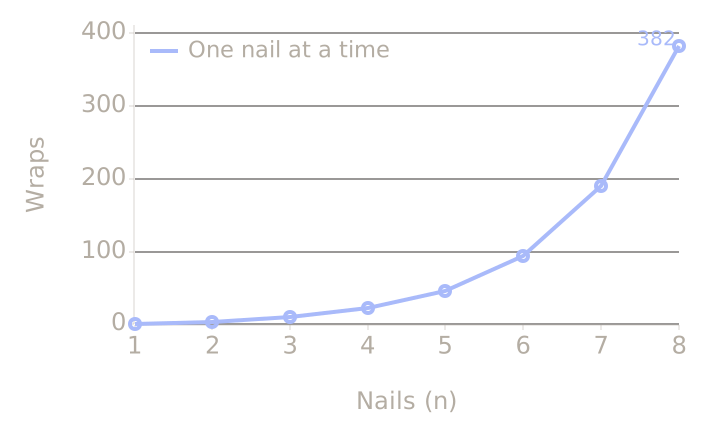
All that wrapping is making you tired. You read somewhere that you should “work smarter, not harder”, so you decide to stop adding nails one at a time.
Say you want to solve for n=4. You already know how to solve for n=2: ABab. For C and D it's also essentially the same: CDcd. Now you only need a way to combine these two.
Remember that when we wanted to avoid Aa reducing right away, we had to add the new nail in the middle and add its undo at the end.
So with this one we can do the same: insert CDcd between ABab and its undo (BAba) and add CDcd's undo (DCdc) at the end.
ABabFirst half
CDcdSecond half
BAbaUndo first half
DCdcUndo second half
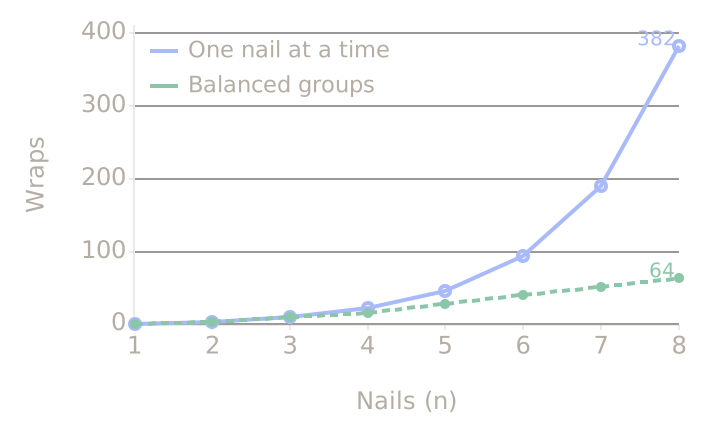
We still do first hanging, second hanging, undo first, undo second. But now we are doing it in batches. Four nails take 16 wraps instead of 22.
fn solve_balanced(n: u8) -> String {
    assert!((1..=26).contains(&n));
    let nails: Vec<String> = ('A'..='Z')
        .take(n as usize)
        .map(|nail| nail.to_string())
        .collect();
    build_balanced(&nails)
}

fn build_balanced(seq: &[String]) -> String {
    // Keep splitting until each group contains just one word
    if seq.len() == 1 {
        return seq[0].clone();
    }

    let (left, right) = seq.split_at(seq.len() / 2);
    let x = build_balanced(left);
    let y = build_balanced(right);
    let undo_x = inverse(&x);
    let undo_y = inverse(&y);
    format!("{x}{y}{undo_x}{undo_y}")
}
At eight nails, we're down to 64 wraps instead of 382. Each nail is still indispensable.
ABabFirst half
CDcdSecond half
BAbaUndo first half
DCdcUndo second half
Back to the cat:
Safety Inspection
Management has discovered that removing any nail causes a catastrophe.
They demand redundancy: either A or B can cover for the other, and so can C or D. The painting should fall only when both nails in either pair are gone.
We can represent that falling condition like this: (A and B) or (C and D).
In the logic representation, letters mean a nail has been removed, not wraps.
(A and B) or (C and D)
First we need a way to represent our rule in code.
enum Rule {
  Nail(u8),
  And(Vec<Rule>),
  Or(Vec<Rule>),
}

use Rule::*;

// (A and B) or (C and D)
let rule = Or(vec![
  And(vec![Nail(b'A'), Nail(b'B')]),
  And(vec![Nail(b'C'), Nail(b'D')]),
]);
A and B has multiple solutions: AB, Ab, aB, ab. Let's choose the first one for now and generalize it: in order to and, we add the first word to the second word.
We already have the code to generate wrapping when any one of the n nails is removed, so we can trivially solve for something like A or B or C or D using our existing build_balanced.
The neat thing is that build_balanced also already works for words as well as letters, so we could give it AB or CD.
For (A and B) or (C and D):
Left AND: X = AB
Right AND: Y = CD
Outer OR: X Y inverse(X) inverse(Y)
Result: ABCDbadc
fn solve_rule(rule: &Rule) -> String {
  match rule {
      Rule::Nail(nail) => char::from(*nail).to_string(),

      Rule::And(rules) => {
          // Solve the inner rule and concat the results
          rules.iter().map(solve_rule).collect::<Vec<_>>().concat()
      }

      Rule::Or(rules) => {
          let words: Vec<_> = rules.iter().map(solve_rule).collect();
          build_balanced(&words)
      }
  }
}
Edge Cases
Consider this rule: A or A. Our current solver produces AAaa which immediately reduces.
Also for (A and B) or (A and C), the solver produces:
X = AB
Y = AC
Word = ABACbaca
Remove B and C:
ABACbaca → AAaa → empty
The picture falls, but the condition is false: both branches require removing A, which is still present.
The problem is that build_balanced doesn't handle repeated letters reliably and can cause unintended cancellation.
In this example we can fix repeated letters by factoring A, giving A and (B or C). But it won't work for all rules; for example, however we factor (A and B) or (A and C) or (B and C), we're still left with repeated letters.
We need a way to make sure each or operation contains only distinct letters. We can do this by converting (A and B) or (A and C) into (A or A) and (A or C) and (B or A) and (B or C). After simplifying: A and (A or C) and (B or A) and (B or C).
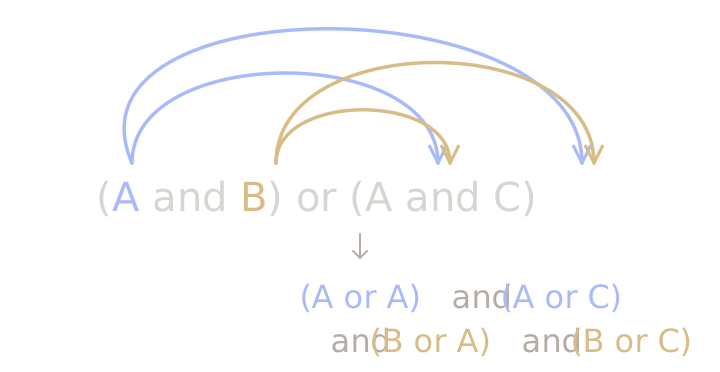
Management has asked us not to mention that mathematicians call this: "conjunctive normal form (CNF): an AND of groups, where each group contains OR-connected letters" because of reasons stated before. So as far as you're concerned CNF means Company Nail Format.
// Outer list: AND
// Inner lists: OR
type Cnf = Vec<Vec<u8>>;

fn to_cnf(rule: &Rule) -> Cnf {
  let mut groups = match rule {
      Rule::Nail(nail) => vec![vec![*nail]],

      Rule::And(rules) => {
          assert!(!rules.is_empty());
          rules.iter().flat_map(to_cnf).collect()
      }

      Rule::Or(rules) => rules
          .iter()
          .map(to_cnf)
          .reduce(distribute)
          .expect("OR needs at least one rule"),
  };

  // Descending starting letters prevent cancellation between boundaries.
  groups.sort_by(|a, b| b[0].cmp(&a[0]));
  groups
}

fn distribute(left: Cnf, right: Cnf) -> Cnf {
    let mut groups = Vec::new();

    for a in &left {
        for b in &right {
            let mut group = a.clone();
            group.extend(b);
            // [A, B, A] -> [A, A, B] -> [A, B]
            group.sort_unstable();
            group.dedup();
            groups.push(group);
        }
    }

    groups
}
How this code works
Let's walk through the code. Given (A or B) and (A or C) we expect a CNF that's:
[
    [A, B],
    [A, C],
]
Base case
Rule::Nail(nail) => vec![vec![*nail]],
Suppose the rule is just Nail(A). CNF still needs to be "AND of OR groups", so we represent it as one OR group containing one nail:
[
    [A]
]
In our familiar notation:
(A)
And
Rule::And(rules) => {
    rules.iter().flat_map(to_cnf).collect()
}
Now consider A and B or rules = [Nail(A), Nail(B)]. First:
rules.iter()
iterates over:
Nail(A),
Nail(B),
Then:
.map(to_cnf)
would give something like:
[[A]]
[[B]]
But flat_map both converts them and flattens one level, so it becomes:
[A]
[B]
and then collect() puts everything into one Vec:
[
    [A],
    [B],
]
OR
fn distribute(left: Cnf, right: Cnf) -> Cnf {
    let mut result = Vec::new();

    for a in &left {
        for b in &right {
            let mut group = a.clone();
            group.extend(b);

            group.sort_unstable();
            group.dedup();

            result.push(group);
        }
    }

    result
}
Suppose we have (A AND B) OR (A AND C); after computing ANDs and ignoring group order for this walkthrough, we're left with:
left=[
    [A],
    [B],
]
right=[
    [A],
    [C],
]
We need to distribute like this:
A with A → A OR A
A with C → A OR C
B with A → B OR A
B with C → B OR C
for a in &left {
    for b in &right {
The loop gives us:
[A] × [A]
[A] × [C]
[B] × [A]
[B] × [C]
For the first pair
a = [A]
b = [A]
we do
let mut group = a.clone();
group.extend(b);
giving
[A, A]
and so on until it becomes:
[
    [A, A],
    [A, C],
    [B, A],
    [B, C],
]
We have to do something about [A, A]. That's why we do this:
group.sort_unstable();
group.dedup();
There are two reasons we sort first: the obvious one is that group.dedup() can only remove consecutive repeated letters; the other reason is that if we have something like (A or B) and (B or A), we would get ABab and BAba. If we were to concatenate them as is, they would immediately cancel each other, so we sort first (notice that sorting doesn't change the logic).
Before the final group sorting, we're left with:
[
  [A],
  [A, C],
  [A, B],
  [B, C],
]
Reduce
Rule::Or(rules) => {
    rules
        .iter()
        .map(to_cnf)
        .reduce(distribute)
        .expect("OR needs at least one rule")
}
Suppose you have A OR B OR C. First .map(to_cnf) gives:
[[A]]
[[B]]
[[C]]
Then reduce(distribute) combines them two at a time. First:
distribute([[A]], [[B]])
gives
[[A, B]]
Then:
distribute([[A, B]], [[C]])
gives
[[A, B, C]]
Final Group Sorting
groups.sort_by(|a, b| b[0].cmp(&a[0]));
For rule (A or B) and (B or C) we're left with [[A, B], [B, C]]. Notice that if we were to join them together as is we would get ABab + BCbc which would reduce at the join boundary. This is because we naively chose the first of four options for AND, but we don't need to check every other option to find a stable joining method; instead we can just sort in descending order by each group's first letter.
Why does that work? In our OR we're already sorting by ascending order and deduping, so for groups with at least two letters, the last letter is guaranteed to be the inverse of a letter alphabetically later than the first. For example if we have BCbc it will only cancel if the next word begins with C, but because we're sorting in descending order, if the next word did begin with C it would have been moved before BCbc, and a word beginning with C cannot end with a smaller letter because of our sorting, so it cannot end with b and cancel.
Converting back to Rule
fn cnf_to_rule(groups: Cnf) -> Rule {
    Rule::And(
        groups
            .into_iter()
            .map(|group| Rule::Or(group.into_iter().map(Rule::Nail).collect()))
            .collect(),
    )
}
let normalized = cnf_to_rule(to_cnf(&rule));
let word = solve_rule(&normalized);
Now you can write any rule using and, or, and parentheses:
See if you can write a rule to fall if any 2 of the 4 nails are removed.
Use A, B, C, D, and, or, and parentheses.
(A and B) or C or D
A Change of Scenery
So far we've been drilling nails into the wall in a relatively straight line, but to your amusement, the wrapping rules don't care where each nail is.
Budget Cuts
There is one final optimization you could do.
fn simplify_cnf(mut groups: Cnf) -> Cnf {
  // Smaller groups can make larger groups redundant.
  groups.sort_by_key(Vec::len);

  let mut kept: Cnf = Vec::new();

  for group in groups {
      let redundant = kept.iter().any(|smaller| {
          smaller.iter().all(|nail| group.contains(nail))
      });

      if !redundant {
          kept.push(group);
      }
  }

  // Restore the ordering used when joining the wrapping words.
  kept.sort_by(|a, b| b[0].cmp(&a[0]));
  kept
}
This converts something like:
[A]
[A, C]
[A, B]
[B, C]
to
[B, C]
[A]
Because those larger groups' logic is already covered by the smaller group.
You've Been Promoted
Congratulations, you can now decide where each nail goes and which ones matter.
Use A, B, C, D, and, or, and parentheses.
The code for this article is available at:
https://github.com/tholoo/hanging-painting-puzzle